Friday, April 17, 2020

The Irreparable Loss

Today there are 2,181,508 confirmed cases of the coronavirus worldwide; 147,337 have died; 554,899 have recovered.  Here in the U.S. we have 671,493 confirmed cases; 33,288 deaths, and 56,236 recovered.  China has revised the Wuhan death toll upward by 50%.  This is a pandemic the likes of which we have never experienced before.  Hopeful signs exist as the so-called “spread” or “curve” has leveled out in some areas, but the virus is still in charge and still causing irreparable loss for families around the globe.  The virus is still in charge and has decimated the world’s economy.  

Is it irreparable?  For the families who have lost loved ones it is irreparable and I wonder every morning if we (all of us, everywhere) really feel their loss (for it is our loss, as well).  I think it is very important that we “feel” and “take-in” the sorrow.  I am not being morbid—I am trying to be human.  I am not being a voice of despair—I am trying to be realistic.  Do we “feel?”  “Where is your brother?  Where is your sister? These are not ancient questions reserved only  of Cain.  They are questions being asked of us in this time.

Everybody is all worked up about the economy.  Everyone is eager for normalcy to return. All of us complain and protest against the “stay-at-home” guidelines.  “Let’s go back,” we shout,  “to the way it was.”  It never will be what it was “once upon a time” for those who grieve the lives of those taken by Covid-19.  Tennyson’s poem, “Break, Break, Break” says it in a way that I cannot.

“Break, break, break,
On thy cold gray stones, O Sea!
And  I would that my tongue could utter
The thoughts that arise in me.

O well for the fisherman’s boy
That he shouts with his sister at play!
O well for the sailor lad,
That he sings in his boat on the bay!

And the stately ships go on
To their haven under the hill:
But O for the touch a vanish’d hand,
And the sound of a voice that is still!”

And then Tennyson pours out a flood of feeling and speaks for those who have suffered irreparable loss with the lines:

“But the tender grace of a day that is dead
Will never come back to me.”


Let not cold statistics rule our minds and hearts and cause them to become numb, without feeling, without care.  Let not our selfish and arrogant desire for normalcy allow us to ignore those who have experienced irreparable loss.  Let us do everything we can, from washing our hands, staying home, and wearing a mask when we go out,  to help prevent any more irreparable losses for our brothers and sisters around the world.  


Thursday, April 16, 2020

Facts, Data, Numbers and Projections

New York Gov. Andrew Cuomo said on March 27, “I operate on facts….Everybody’s entitled to their own opinion, but I don’t operate here (in the midst of a pandemic) on opinion.  I operate on facts and on data and on numbers and on projections.”  A “Fact” is defined as “something that is known to have happened or exist, especially something for which proof exists, or about which there is information.”  Mr. Cuomo’s facts (at that time) were based on projections from Weill Cornell Medicine, the CDC and McKinsey (a global management consulting company) which suggested that thousands more ventilators would be needed in New York to combat the ever-growing number of Covid-19 patients.

Mr. Trump, said Cuomo, was operating on “opinion” when he spoke to Sean Hannity of Fox News and said that he didn’t really think all those ventilators were needed in New York. “I don’t believe you need 40,000 o 30,000 ventilators.  You know, you go into major hospitals, sometimes they’ll have two ventilators.  And now all of a sudden they’re saying, ‘Can we order 30,000 ventilators?’” And as it turns out, thankfully,  New York did not need all those ventilators.  Opinion vs. Fact.  Would New York have needed those ventilators if social distancing and other drastic measures had not been put in place to change the course of the information and data Cuomo had at his disposal at the time of his request?  

Will we “operate on “facts” or “opinion?”  Will we follow the dictates of science and rationality?  (Rationality is defined as acting “in accordance with reason or logic”).  Or will we succumb to opinion, which is defined as “a view or judgment formed about something, not necessarily based on fact or knowledge?”

Deborah Jane Orr wrote in the Guardian back in 2017:  “Humans like to think we are rational.  Some of us are more rational than others.  But, essentially we are all slaves to our feelings and emotions.”  We think it is our right to make half-formed judgements, based on little more than how we feel or based on our political or religious biases.  Can people be relied upon to make rational choices is a big question right now.   So many opinions are out there, in print and online, that have caused us to think that experts are overrated, data is unreliable, science is suspect, and anything that we don’t particularly like is “fake news.”  We are all part of the problem.

We are living in the midst of a global pandemic.  Current data indicates 2 million confirmed cases today and 138,000 deaths worldwide (this is not a projection—this is a fact). I don’t like the data, but that doesn’t mean it is fake news.  I don’t like the social distancing that has been imposed, but data shows that it has had an effect on the spread.  I am trying to operate, with Cuomo, on facts based on reliable data provided by experts and health professionals.  How about you?


Wednesday, April 15, 2020

Dr. WHO?

As of yesterday, there were 1,878,489 confirmed cases of the Coronavirus in 213 countries. Nearly 120,000 people have died worldwide.  As of 12 April, there were 578,268 confirmed cases of the Coronavirus in the U.S. with a death toll of 23,476.  For those who want always to hear the “positive” there are currently 1,758,489 persons who have survived the virus.  (W.H.O)

The above statistics indicate that the Coronavirus is a worldwide pandemic involving 213 countries.  It is not just an American problem or crisis—it is a global crisis!  The virus is no respecter of nationality, race, age, or religion.  It does not discriminate (though the disparities among some groups is becoming more evident).  The death of a person in Italy, China, Spain or the U.K. is  just as devastating and heart-breaking as the death of a person in the U.S.A.  No nation is entire unto itself—it is a part of the main—and what happens here or there is what is happening everywhere.  The social distancing, the economic catastrophe, the loss of jobs and income, the frustration and inherent fear of what will be is not just the  American peoples burden—it is one shared with 212 other countries.

This is not the time, in the midst of all that we as a global community are facing, to play the “blame game.”  It is not the time to project on others that which we are unwilling to face within ourselves. Every nation, every national leader, every governor and mayor, every government, every health organization, every person, if honest, will say, “We should have done it better and sooner.  We should have been more prepared.  We should have seen it coming.”  But, rather than face our own short-comings, we tend to cast the blame on China or the World Health Organization, the media, the president, the congress,  the prime minister, or whoever else we can find who didn’t quite meet the challenge the way we think it should have been met.  This is not the time to be playing games of blame or any other kind of game at all! 

It is time to be cooperative, to share the burden and even the blame (if blame there has to be), to put our best scientific minds to work, to mourn together, to be a team together, to share our common sorrow, to do what has to be done, not as one people in one particular place, but as a global community.  

A vaccine may not come from an American scientist or the CDC.  It may come from some obscure health lab in Burundi, or Ghana, or Nigeria, or perhaps Brazil, Zimbabwe, Iran, China or Egypt. It is not wise to blame  Doctor WHO.  Doctor WHO may not be the problem; Doctor WHO may be our hope and our salvation.


Tuesday, April 14, 2020

Living In The Moment

Has there ever been a “time” like this time?  Not really.  While history may repeat itself on occasion, it never repeats itself in the same time period.  Nor does it precisely replicate one historical event in quite the same way as it did the first-time around.  Famines, plagues, economic disasters, even “stay-at-home” quarantines have been experienced before our time, and there is little doubt that such things will occur in another time long after this time has passed.

The Plague of Athens (circa. 429 BC), probably Typhus or Typhoid Fever, took 100,000 lives.  The Antonine Plague in the Roman Empire (circa. 165), probably Smallpox, took an estimated 5 to 10 million lives.  Over 75 million lives (60% of the population of Europe) were lost in what is now called the Black Plague in 1331-1353.  Ebola, measles, influenza, bubonic plague, H1N1, Yellow Fever, Cholera and many other epidemics have had their day—and now, Covid-19—a worldwide pandemic, has taken over 120,500 lives (as of April 14, 2020).

I remember a summer in the early 1950’s when infantile paralyses (polio) was rampant in our community.  The doctor who brought me into this world lost his eldest son that year to the disease.   I can remember my mother’s fear for us. We weren’t allowed to go swimming in the brook and our contact with other children was limited.  The first  U.S. polio epidemic occurred in 1894.  Salk’s vaccine didn’t arrive on the scene until 1953.  

Yes, there have been times like this time before, but none were quite the same as this time.  The historical perspective doesn’t make it any easier for us, but it ought to give us hope, and it ought to help us do what needs to be done right now.  

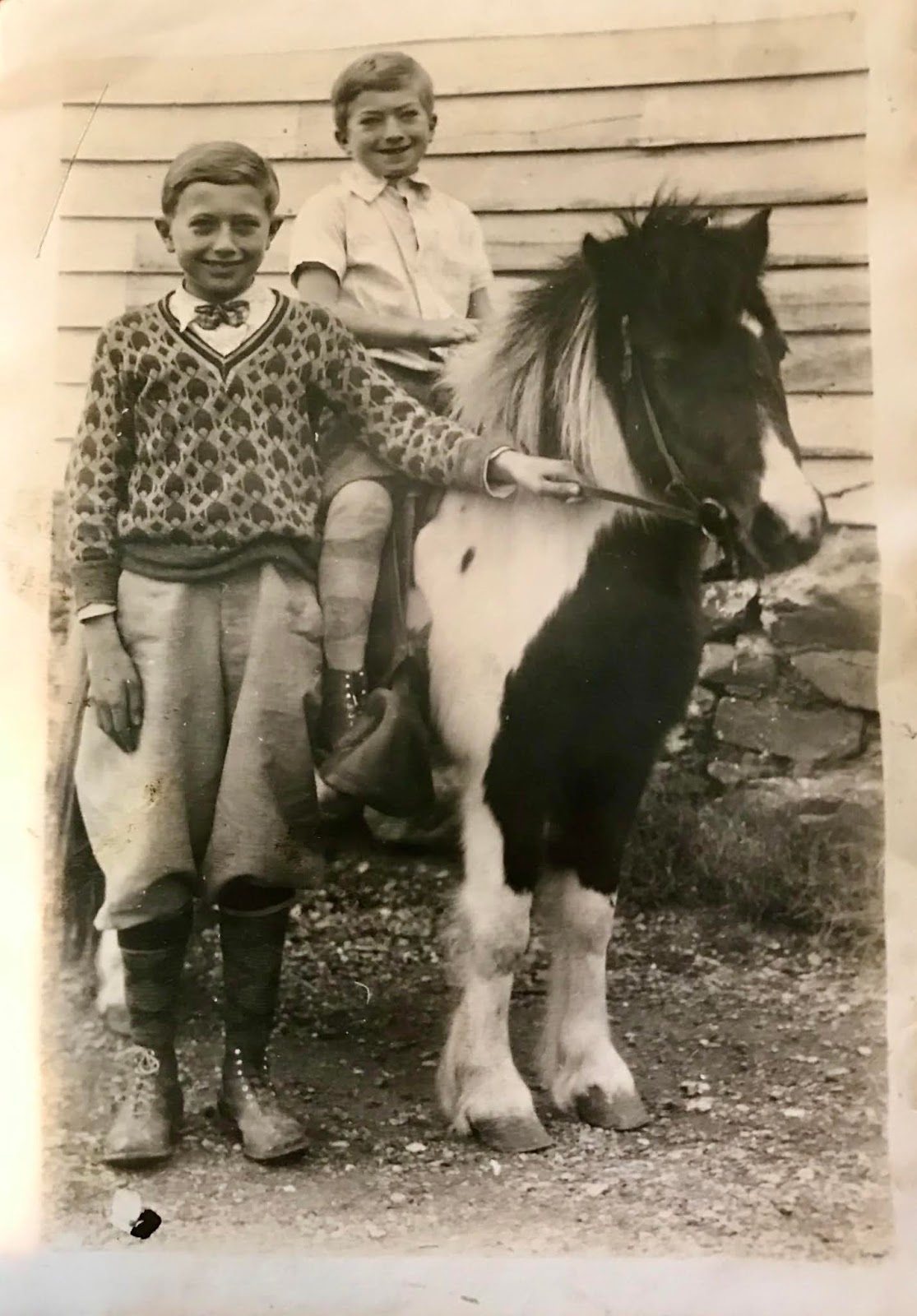
In 1928, prosperity (for the privileged) was not just an economic condition; it was a state of mind.  Everything was “great, terrific, incredible,” etc.  Then suddenly, on October 24, 1929, the economic world crashed with a sudden and brutal shattering of hope.  People found themselves in an altered world of joblessness and poverty.  My father’s family was not part of that prosperity, but  were deeply affected by what we now call “The Great Depression.”  My Dad was 11 or 12 years old in October 1929.  He made it through, though not without great difficulties, and lived for another 70 years.  When I look at the photograph of him taken in 1929, it is apparent that “The Great Depression” was not about to do him in.  Nor will the present pandemic and the economic downturn of the present moment do us in.  We, too, will live through it, but only if we do what needs to be done right now.

Dad and his younger brother (my name sake) Harold
in 1929


Monday, April 13, 2020

“Time” in this Time

There is the precious gift of “time” in this “stay-at-home” time.  Time to catch up on what needs to be caught up. Time to think.  Time to remember.  Time to reflect. Time to read.  Time to listen.  Time to question.  Time to do.  Time to cry. Time to pray. Time to ponder. Time to love.  Time to care. How are you doing with your “time” in this staying at home time?  William Penn’s epigram about “time” from his book “Some Fruits of Solitude,” written in 1682 come to mind:  “Time is what we want most, but what we use worst.”  

I’ve wanted “time” for a long time to do “this" or to do “that”.  I should, for example, take time in this “time” to read that little book of Penn’s again.  I can remember saying in another time and place,  “When I retire and have the “time” I want to read this or that book again.”  Well, the time has come, lots of time, without any disturbance or interruption.  The books await me.  

I read again over the weekend Mitch Albom’s wonderful book, “Tuesdays With Morrie”.   The reading prompted memories of George, just one such Morrie in my journey.  How fortunate I feel and how grateful I am for the gift of so many Morries!

George and I met in 1968.  I was 25 years old; George was 56 years old.  He was a retired school teacher and columnist for the local newspaper; I was just starting out.  Our relationship spanned nearly a half century (George died in 2007).  

“Yes, time is precious,” George wrote me from his assisted living home.  “I have been blessed by being given some extra time.  I hope I have used and am using it wisely and what little I do has some worthwhile effect on the people around me.”  

“Ninety-one is just about the same as ninety,” George wrote, “though there are semblances of additional barnacles—like chronic ache in the back and frequent instances of insomnia.  I feel pretty much alive at the moment…My cardiologist examined me yesterday and suggested that I am good for a few more years.  I will try to oblige him—reinforce his considered opinion. We shall see.”

On the occasion of my father’s death, George wrote:  “I think of my father everyday and sometimes many times during that day.  He will have been dead 58 years tomorrow.  He was 80 years old plus exactly six months.  I experience the same feelings as those that you do.”  I know I have given this to you before, but here goes”
“When Father took my by the hand,
I had no thought of fear;
And even now, when trials come,
I feel his presence near.

Time! Precious time! Special people within time.  Memories that hold time.  “Time is what we want most…” We have been given the gift of “time” within this time.


Saturday, April 11, 2020

Good Friday Long Ago

The year was 1962—58 years ago—I was 19 years old.  The place was the Island of Crete.  The day was Good Friday.  A Greek friend invited me to attend the Orthodox Good Friday service.  The women of the church create the Epitaphios (the tomb of Christ) decorated with fresh flowers which is placed in the front of the church.   In the center of the Epitaphios is an elaborately embroidered cloth with the image of Christ on it.  The icon of Jesus is removed from the cross and wrapped in linen and put in the Epitaph (the tomb).

At the close of the worship service, the Epitaph is carried out of the church and into the streets of the village followed by the faithful worshippers with lighted candles.  The Church bells peal slow, deep funeral tones, the priests chant, incense is burned, and the people sing solemn hymns.  Eventually the procession makes its way to the local cemetery where the women begin to cry and wail for those whom they have lost in death, and a funeral service is conducted for Jesus in the present tense.   

That’s what I remember. The experience took root in my consciousness and has remained there ever since.  The experience made me aware of the power of death. This power of death takes many forms.  It exists everywhere.  It is any power that denigrates our humanity, any power that makes us less than what we are, any power that takes life (our humanity) away from us, including the worldwide Coronavirus pandemic that presently envelops us. 


Contrary to the way many Christians interpret the Bible, the Bible itself concentrates upon events as they happen in this world as it is.  The Bible focuses upon societal realities of every description as they exist in time.  Biblical faith is concerned with this world. Biblical faith is lived out within the human situation as human beings experience it.  And what this faith affirms is that this time and this place and all experience in this world, fallen as it is, is the subject of God’s concern and incessant love and action—“For I have seen the affliction of my people in Egypt…I have heard their cries…I have taken heed of their sufferings (Exodus 3:7).”  In that cemetery long ago, I sensed God’s presence.  I felt God heard the chanting of the priests, the solemn hymns of the people, the pealing of the Church bells, the crying of the women and even smelled the burning incense.  I sensed God felt the sorrow they expressed in their mourning.  It seemed to me that I  heard God crying with them, expressing his own deep sorrow for the death of their beloved and his own.  Easter happened that night because God was there.  Easter happens because God is here, and there, and everywhere, suffering in, and at the same time transfiguring and redeeming what is.


Friday, April 3, 2020

A Season of Lament

The number of victims multiply and the coronavirus spreads.  The largest single-day increase of new coronavirus cases worldwide occurred yesterday.  The number of cases worldwide has now exceeded 1 million.  The U.S. is the new epicenter with over 245,000 cases (more than any other of the 171 countries inflicted with the virus).  Over 6,000 Americans have died from COVID-19.  This is the new reality.  It cannot be swept under the rug.

Public health experts, including Dr. Anthony Fauci, say the only way to lower the spread is through social distancing and staying at home.  “If you back off, and you don’t mitigate,” Fauci told CNN, “there is a possibility that number (of deaths) will go up…And that is the worst possible thing in the world you want to see.  And that’s the reason why I am so adamant about when we say we have got to follow those guidelines, you really got to take it seriously.”  

Some governors have been reluctant to order “shut downs” and remain reluctant to take the virus seriously.  At the national level, though we are willing to “shut down” the government over some political or partisan divide, we seem unwilling to “shut down” in the midst of a pandemic.  If we see the present challenge as “a war” then let us declare war and put the whole of the country on a wartime alert (a complete and national shutdown).   Some churches refuse to close their doors, even while being told that religious gatherings are proven hotbeds for the virus.  Some people refuse to stay at home.  To really  “Love One Another” right now is a matter of keeping our distance from one another!


We want it to be over.  We want an explanation.  We pray to the One who calmed the wind and the sea.  We want relief.  But, N.T. Wright suggests, that  what we might need more is to recover the biblical tradition of lament.  “Lament,” Wright says, “is what happens when people ask, ‘Why?’ and don’t get an answer. It’s where we get to when we move beyond our self-centered worry about our sins and failings and look more broadly at the suffering of the world.”